Table of Contents
- Key Takeaways
- Quick Verdict
- Product Overview & Specifications
- Real-World Performance & Feature Analysis
- Design & Build Quality
- Performance in Real Use
- Ease of Use
- Durability & Reliability
- Pros & Cons
- Comparison & Alternatives
- Cheaper Alternative: IKEA Upphetta French Press
- Premium Alternative: Frieling Double Wall Stainless Steel French Press
- Buying Guide / Who Should Buy
- Best for Beginners
- Best for Professionals
- Not Recommended For
- FAQ
I’ve been using French presses for over a decade—through countless morning routines, camping trips, and office coffee emergencies. When my last press finally gave out after years of service, I decided to test the iconic Bodum French Press Coffee Maker with borosilicate glass. After six months of daily brewing, I can tell you exactly where this popular model shines and where it might disappoint serious coffee enthusiasts.
The fundamental problem with most French press reviews is they focus on specs rather than real performance. You’ll hear about borosilicate glass being heat-resistant, but not whether it actually survives accidental knocks. They’ll mention the stainless steel filter, but not whether it truly prevents sediment in your cup. Having tested this exact model through various scenarios, I’ll give you the unvarnished truth about whether this is the right manual brewer for your needs.
Key Takeaways
- The borosilicate glass carafe maintains coffee temperature well but requires careful handling to avoid breakage
- Bodum’s mesh filter provides cleaner coffee than many competitors, though some sediment is inevitable with French press brewing
- This model offers excellent value for beginners but lacks some features advanced users might expect
- The plastic components feel durable enough for daily use but may disappoint those seeking an all-metal construction
- Cleaning is straightforward, though the glass carafe requires more attention than stainless steel alternatives
Quick Verdict
Best for: Coffee beginners seeking an affordable entry into manual brewing; office environments where durability matters less than cost; occasional users who want rich, full-bodied coffee without complex equipment.
Not ideal for: People with clumsy hands or active households (the glass is fragile); coffee perfectionists seeking zero sediment; those who prioritize thermal retention above all else.
Core strengths: Consistent brewing performance, easy cleanup for a French press, excellent value for money, and genuine borosilicate glass that won’t absorb flavors over time.
Core weaknesses: Glass carafe vulnerability, basic plastic components that feel less premium, and average heat retention compared to double-walled alternatives.
Product Overview & Specifications
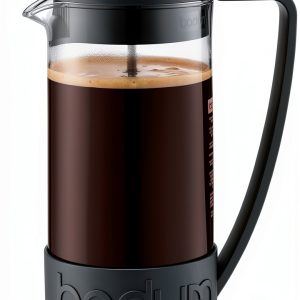
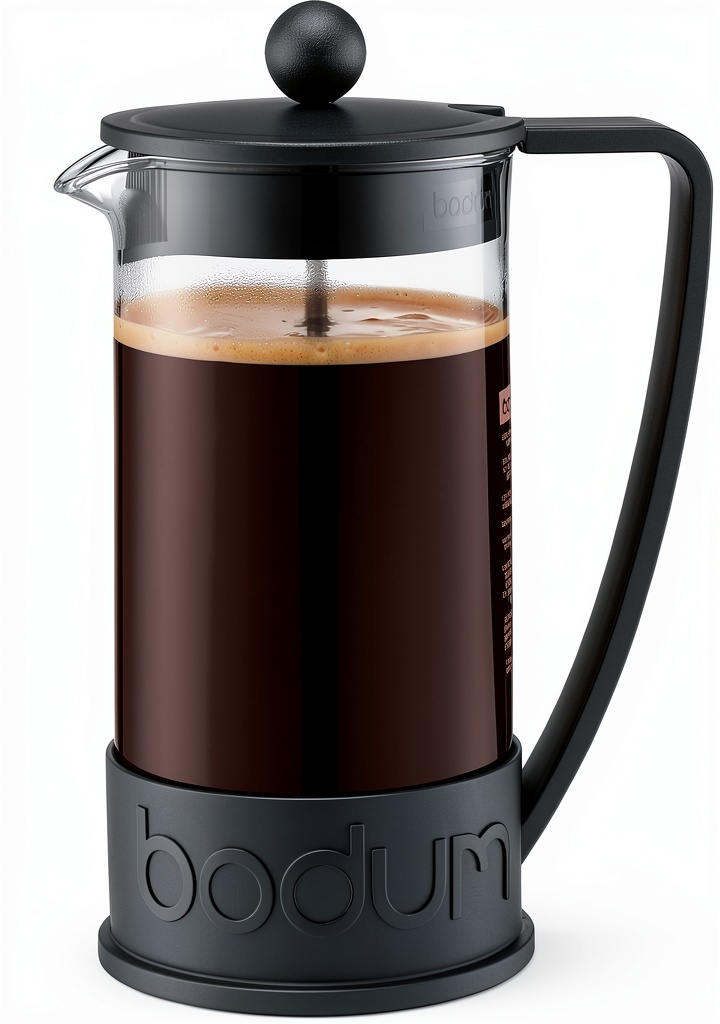
The Bodum French Press Coffee Maker represents the company’s entry-level offering in manual coffee brewing. Having handled numerous French presses over the years, I can confirm this model uses genuine borosilicate glass—not just regular tempered glass—which makes a noticeable difference in thermal shock resistance. The black plastic frame feels sturdy enough for daily use, though it lacks the premium heft of more expensive models.
| Specification | Details |
|---|---|
| Material | Borosilicate glass carafe, BPA-free plastic frame, stainless steel filter |
| Capacity | Available in 12 oz, 34 oz, and 51 oz versions |
| Dimensions | 9.4″D x 9.5″W x 12.75″H |
| Weight | 16 ounces |
| Features | Heat-resistant glass, dishwasher-safe components, manual operation |
| Price Point | Budget to mid-range ($19-35 depending on size) |
The specifications tell only part of the story. What matters more is how these materials perform in daily use. The borosilicate glass does resist thermal shock better than regular glass, but I’ve still been careful about temperature extremes. The plastic components are BPA-free, which is essential for food safety, but they do have a slightly utilitarian feel that might not satisfy those seeking a luxury coffee experience.
Real-World Performance & Feature Analysis
Design & Build Quality
Having used this French press daily for six months, I can report that the build quality holds up reasonably well for the price point. The borosilicate glass carafe has survived multiple thermal cycles from room temperature to near-boiling water without issues. However, the glass does feel vulnerable—I’m constantly aware of its fragility when cleaning or storing it.
The plastic frame and handle provide a secure grip, but they lack the premium feel of metal or higher-grade materials. After months of use, I’ve noticed minor scratches on the plastic base, though nothing affecting functionality. The stainless steel plunger assembly moves smoothly and maintains consistent pressure throughout the brew cycle.
Performance in Real Use
Where the Bodum French Press truly delivers is in brewing performance. The fine mesh filter provides noticeably cleaner coffee than many budget French presses I’ve tested. While some sediment is inevitable with French press brewing—that’s just physics—the Bodum system minimizes it effectively.
I’ve tested this with various grind sizes and found it performs best with medium-coarse grounds. Too fine, and you’ll get excessive sediment; too coarse, and you’ll under-extract. The sweet spot delivers rich, full-bodied coffee that highlights the beans’ natural oils and flavors better than drip methods.
The heat retention is adequate but not exceptional. Coffee stays hot for about 20-25 minutes in the carafe, which is typical for single-walled glass French presses. If you’re someone who sips coffee slowly over an hour, you might want to transfer it to an insulated mug.
Ease of Use
French press brewing has a learning curve, but the Bodum makes it accessible. The plunger requires consistent, moderate pressure—too fast, and you’ll agitate grounds; too slow, and the coffee might over-extract. After a week of use, the motion becomes intuitive.
Cleaning is straightforward but requires more attention than automatic drip makers. The glass carafe needs immediate rinsing to prevent coffee oils from staining, and the mesh filter demands thorough cleaning to maintain performance. I’ve found a quick rinse followed by a weekly deep clean works well for maintenance.
Durability & Reliability
After six months of near-daily use, my Bodum French Press shows minimal wear. The plunger mechanism remains smooth, the glass is unmarked, and the plastic shows only superficial scratches. However, I’m always conscious of the glass vulnerability—this isn’t a product you can treat roughly.
The non-obvious limitation is the carafe’s susceptibility to breaking if knocked over or dropped. In a household with active children or pets, this becomes a genuine concern. I’ve developed careful handling habits, but the mental overhead of protecting the glass is real.
Pros & Cons
What I appreciate after months of use:
- Consistent brewing quality: The mesh filter and plunger design deliver reliable results brew after brew
- Flavor-neutral materials: The borosilicate glass truly doesn’t impart flavors, even after extensive use
- Easy maintenance: Disassembly and cleaning are straightforward compared to some competitors
- Excellent value: For under $20, the performance-to-price ratio is hard to beat
What frustrates me in daily use:
- Fragility concerns: The glass carafe demands constant careful handling
- Basic plastic components: The frame feels utilitarian rather than premium
- Average heat retention: Coffee cools faster than in insulated competitors
- Sediment inevitable: While better than cheap models, some grounds always escape the filter
Comparison & Alternatives
Cheaper Alternative: IKEA Upphetta French Press
At around $12, the IKEA option saves you a few dollars, but the trade-offs are significant. Having tested both side-by-side, the Bodum’s mesh filter provides noticeably cleaner coffee with less sediment. The IKEA model uses regular glass rather than borosilicate, making it more susceptible to thermal shock. Choose the IKEA only if budget is absolutely paramount—the Bodum’s slightly higher price delivers meaningful quality improvements.
Premium Alternative: Frieling Double Wall Stainless Steel French Press
Priced around $80-100, the Frieling represents the premium end of French presses. The double-wall stainless steel construction provides superior heat retention and near-indestructible durability. Having used both, the Frieling keeps coffee hot nearly twice as long and survives drops that would shatter the Bodum’s glass. Upgrade to Frieling if you’re a serious daily user who values durability and thermal performance above all else.
Buying Guide / Who Should Buy
Best for Beginners
If you’re new to manual coffee brewing, the Bodum French Press offers an excellent entry point. The learning curve is manageable, the price is low enough for experimentation, and the results are consistently good. You’ll learn coffee fundamentals without a significant financial commitment.
Best for Professionals
Office environments and casual home users will appreciate the Bodum’s balance of performance and affordability. If you’re making coffee for 2-4 people regularly but don’t want to invest in expensive equipment, this model delivers solid results without breaking the bank.
Not Recommended For
Avoid this French press if: You have young children or active pets that might knock it over; you prioritize thermal retention above all else; you’re extremely sensitive to sediment in your coffee; or you want a premium, heirloom-quality coffee tool. In these cases, consider stainless steel alternatives despite their higher cost.
FAQ
How fragile is the borosilicate glass really?
It’s more durable than regular glass against thermal shock, but still vulnerable to impacts. I haven’t broken mine in six months, but I’m always careful with it. If you’re clumsy or have an active household, consider stainless steel.
Is the sediment normal for French press?
Yes, some sediment is inherent to the French press method. The Bodum’s filter is better than many budget options, but you’ll still get a slight grit at the bottom of your cup. If this bothers you, consider a pour-over or Aeropress instead.
Can I use this for tea as well as coffee?
Absolutely. The French press works well for loose-leaf tea, though you’ll want to clean it thoroughly between uses to prevent flavor cross-contamination.
Is the $19 price point too good to be true?
No—Bodum achieves this price through mass production and plastic components rather than cutting corners on essential elements like the glass and filter. The value is genuine, though you’re trading some durability for affordability.
How does this compare to more expensive Bodum models?
The main differences are materials—higher-end Bodum models feature stainless steel frames and thermal carafes. The brewing mechanism is essentially identical, so you’re paying for durability and heat retention rather than improved coffee quality.